/*A forensic breakdown of micro, small, and mid-market businesses: how they think, what drives every decision, where the needs become acute, and why the companies best placed to serve them keep misjudging the opportunity. This is a further build up from my previous article on Telcos & SMEs – read for additional background*/
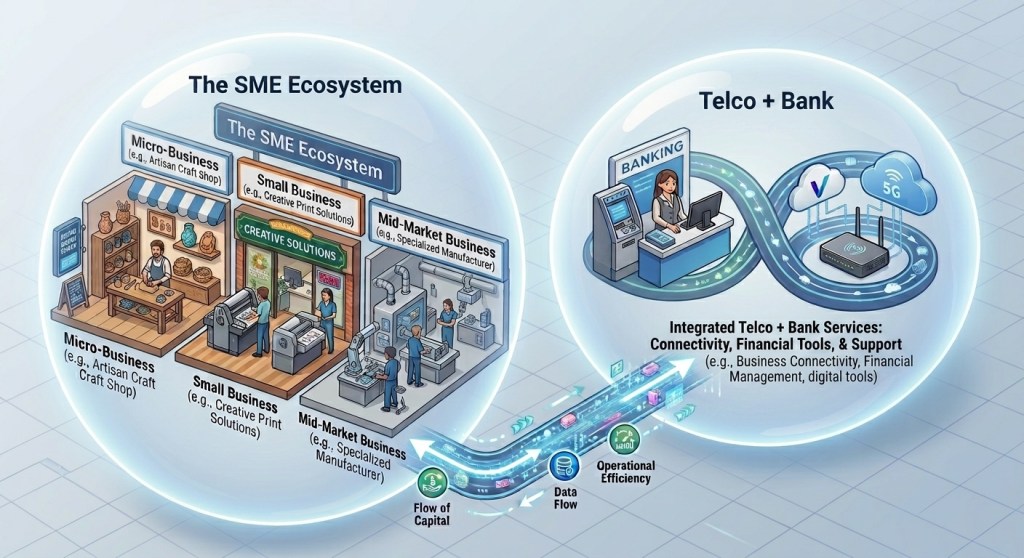
The very first and fundamental mistake large corporates do when they deal with this segment is terming it as “SME”. Taking a broad-brush lens to define the segment, its expectations and needs. Beneath that umbrella sit three fundamentally different economic organisms, each with its own psychology, its own buying logic, its own relationship with money and technology, and its own criteria for trust. A sole trader running a food stall in Jakarta and a 120-person logistics company in Kuala Lumpur are both technically SMEs. They have almost nothing else in common.
Everything that follows from that misclassification, the generic product design, the one-size-fits-all pricing, the misdirected sales channels, the repeated failure to build meaningful relationships, flows directly from that original error. To fix the strategy, you have to start by dissecting the segment properly. So that is where this article is going to start. What’s the standard definition of this segment – 3 broad categories based on business size.
| Micro Businesses 1-10 employees, sole trader to small team | Small Businesses 10-49 employees, structured but still owner-led | Mid-market Businesses 50-249 employees, structured operations, departmental heads, multiple stakeholders |
But we all know this already, isn’t it?
The problem is not about knowing what SMEs are. It’s about understanding who they are.
PART I: Who they actually are and what matters to them?
Micro Business
The micro businesses are the most numerous and the most misunderstood business segment on earth. These are not businesses in the early stages of becoming something larger. Most of them are not trying to scale. They are owner-operated livelihoods, where the business and the owner’s personal finances are effectively the same entity.
The owner of a micro enterprise is almost always the same – CFO, the CEO, the head of sales, the IT department, and the delivery driver. There are no separate functions because there is no one to separate them into. The decision-making framework is survival and that’s all. Research published in the International Journal of Multidisciplinary Research (IJMRA 2025) confirms that micro-business owners rely predominantly on simplified routines, trial-and-error methods, and reactive decision-making rather than formal analysis or planning.
Anatomy:
Financial behavior: Informal, mixed, and reactive
Financial practices are predominantly informal: minimal record-keeping, mixing personal and business finances, reliance on daily cash flow. Only 1 in 4 micro-entrepreneurs use a formal budgeting system despite recognizing its importance. Loss aversion and psychological biases dominate financial decisions.
What drives buying decisions: Trust, simplicity, and word-of-mouth
If they need anything, they ask people they know. They buy from providers they have seen before. Price sensitivity is high, but the bigger barrier is complexity: if it takes more than 10 minutes to understand a product, the answer is no. Peer referral and community reputation are the dominant acquisition channels at this tier.
Technology relationship: Mobile-first, tool-resistant, time-poor
Digital literacy is the primary barrier. GoDaddy’s 2023 Venture Forward report found that learning digital technologies, building a website, and managing social media are the top challenges of micro-business owners. They use mobile devices and computers daily but rely heavily on mobile data and are acutely sensitive to complexity and onboarding friction.
Relationship with Institutions: Skeptical, underserved, and cautious
The IFC estimates 55% of SMEs in developing countries have no credit access at all. Most micro owners have been turned down by banks for lacking collateral or credit history, and many have resolved to stop trying. They borrow from family, informal lenders, or not at all. Trust in formal institutions is low. The same skepticism and cautious behavior prevail in all business interactions including telcos.
At the micro level, these behavioral aspects turn into 3 existential questions: Can I get paid today? Can I stay solvent this week? And can I grow without needing to hire someone I can’t afford?
Small Business
Small business is all about consolidation. This is the segment that has cleared the first hurdle: it has found a market, built a repeatable product/service, and brought in enough people that the owner no longer does everything alone. But the transition from doing everything to directing others is one of the most structurally difficult periods a business goes through, and very few external providers understand or serve it well.
At this level, the owner is still the primary decision-maker on significant purchases, but the dynamic is shifting. A 10-person software company has a founder who is also the sales director, a de facto head of ops, and probably still coding on Fridays. A 40-person manufacturing firm has a layer of managers who influence decisions but rarely own them. This is the segment where the single decision-maker assumption begins to break down, but the buying committee does not yet exist in any formal sense.
Anatomy:
Financial behavior: Revenue-focused, credit-constrained
Small businesses have revenue but often lack the tech, tools and financial history or collateral to access credit/services on reasonable terms. SAP Fioneer research finds that only 12% of small businesses describe the affordability and availability of new finance as good, with 51% rating it as poor. Cash flow management is a constant preoccupation, but the sophistication to address it systematically is rarely present without external tools or advice.
What drives buying decisions: ROI speed, ease, and peer validation
For small businesses, a 2-4 week sales cycle is reasonable. The CEO or founder is typically the economic buyer (Belkins B2B Buying Committee Study, 2026). The key question is not “what does this do?” but “how quickly will I see the difference?” B2B buyers are 50% more likely to purchase when they see personal value alongside business value. Case studies from businesses their size and sector outperform all other forms of persuasion.
Technology relationship: Aware, willing, but overwhelmed by choice
Small businesses know they need cloud tools, CRM, and cybersecurity. Techaisle’s 2024 survey of nearly 5,000 businesses found that only 13% of EU enterprises with 10+ employees were using any AI as of 2024. The barrier is not awareness, it is evaluation complexity and the fear of choosing wrong. Small businesses rarely have an IT function to filter options. The decision falls to the owner or a manager who has 15 other things on their list.
Relationship with Institutions: Willing but disappointed by the experience
Small businesses want to buy more from their bank and telco. Multiple studies have found that good online and mobile based services is now the number-one reason for SMEs selecting their primary service provider, and its true for their banking or tech services needs. They are digital-active and ready to engage, but they have been given portals that don’t serve them and call centers that route them to consumer teams. The demand exists, but the experience consistently fails it.
Small enterprise needs sit at the intersection of operational continuity and growth ambition. The owner of a 25-person business is not thinking about survival anymore. They are thinking about whether they can handle 50 people, whether their clients are loyal enough to resist a competitor’s pitch, and whether their data is secure enough not to make the news. These are qualitatively different problems from the micro tier, and they require qualitatively different responses.
Mid-Market
The mid-market business is a structurally distinct animal from the small business. It has department heads, a CFO who is separate from the CEO, a purchasing process that involves multiple stakeholders, and enough operational complexity that technology is no longer optional. It is also the segment that both banks and telcos find hardest to serve well: too complex for the consumer or SME teams, too small for the enterprise desk.
Buying decisions at this level involve a buying committee even when no formal committee has been declared. The CEO in a 100-person company sets strategic priorities but typically delegates vendor evaluation to functional executives. The CFO controls budget and asks the ROI question. The CTO or IT lead evaluates technical fit. A mid-level manager often makes the initial recommendation. According to the Belkins B2B Buying Committee Study (2026), the expected sales cycle for mid-market is 4 to 8 weeks, with follow-up cadences of 5 to 7 days between touchpoints. The sales motion for this segment looks nothing like SME and nothing like enterprise.
Anatomy:
Financial behavior: Strategic, data-driven, ROI-obsessed
Cherry Bekaert’s 2025 CFO Survey of 200 mid-market finance executives (revenue $5M–$250M) found the finance function is undergoing rapid modernization. CFOs are reducing monthly close cycles, automating reporting, and demanding real-time data visibility. 81% of CFOs across this band cite cash flow improvement as a top strategic focus (Amex CFO Survey 2024). The financial sophistication exists, but the enabling technology and banking infrastructure often does not match it.
What drives buying decisions: Multiple stakeholders, structured evaluation
At this tier, no single person decides alone. A champion inside the organization is essential. Security and reliability are the most important vendor selection criteria (Gartner Digital Markets 2024), followed by cost, with CSR values increasingly influential.
Technology relationship: Intentional, complex to implement
The NCMM Q4 2025 Middle Market Indicator shows 53% plan near-term AI investment, and digital transformation now competes directly with AI as a top priority. But mid-market firms face a talent paradox: they need specialist IT skills to implement digital transformation but cannot compete with enterprise salaries to hire them. Managed services partnerships that fill skills gaps without overburdening internal teams are the practical answer most have not yet found from their service providers.
Relationship with Institutions: Demanding, analytically engaged, and underserved
Mid-market companies engage analytically with financial and technology providers. They read whitepapers. They evaluate proposals rigorously. But they consistently report that neither their bank nor their telco has a proposition built for their actual operating context. Too complex to be served by the SME team, too small to get enterprise-level attention, they fall into the service gap.
Mid-market needs are shaped by a structural tension: the scale of the ambition is enterprise-grade, but the resources, processes, and external support available are often still small-business level. The moment this segment’s needs become acute is typically a moment of growth inflection: a new market entry, a major contract win, a hiring wave, or a digital transformation project that has been deferred too long. These events create buying windows that are relatively short and require a provider with both the depth and the speed to respond.
PART II: Where the needs become opportunities for external support?
Every need identified in PART I has a provider gap sitting beside it. The question is not whether the opportunity is real, it is who moves to fill it, when, and with what form factor.
Details below define the five core need domains:
Domain 01: Financial access and cash flow
The IFC estimates a $5.2t annual unmet MSME financing need in developing countries, equivalent to 1.4 times the current level of global MSME lending. At the micro level, the need is micro-credit that does not require collateral. At the small level, it is working capital linked to receivables. At mid-market, it is structured trade finance, revolving credit, and supply chain financing. None of these needs are difficult to meet in principle. The difficulty is in the delivery model: banks have historically required collateral and credit history that SMEs cannot provide, and the transaction cost of serving small loans has made the economics look unattractive. Digital lending changes both constraints; real-time transaction data replaces credit history, automation reduces the cost-to-serve, embedded banking inside the platforms SMEs already use daily removes the acquisition cost entirely.
Domain 02: Security
SMEs invested $107b in cybersecurity in 2023. By 2028, they will represent 62% of all cybersecurity expenditure globally, growing at 10% CAGR. 74% of SME owners self-manage cybersecurity without sufficient training. One in three experienced a successful cyberattack in the prior year. These statistics describe an acute need combined with a persistent delivery gap. The opportunity for providers is not to sell security software: it is to offer managed threat detection and response as a subscription that runs invisibly in the background, bundled to the connectivity contract. The SME owner does not want to think about security. They want to know they are protected.
Domain 03: Connectivity and infrastructure as a managed layer
Gintel Research makes a point that is simple but consistently ignored in practice: the telecom service needs of a micro business, a small business, and a mid-market company are materially different. A single “SME offer” cannot serve all three. Connectivity for a micro enterprise is a mobile SIM and affordable data. For a small business, it is multi-line business mobile, cloud PBX, and fibre broadband. For a mid-market firm, it is SD-WAN across multiple sites, unified communications, and managed network services with SLA accountability.
Domain 04: AI and time savings
The most acute problem for owners across all three segments is “time”. The owner of a five-person business who manages operations, sales, and delivery personally does not need a better AI platform: they need 90 minutes back every day. I covered it in my previous article on Telcos & SMEs: Deutsche Telekom’s Voice AI Notes product, launched in September 2025, understood this: it automatically records, transcribes, and summarizes phone calls. Jio’s Haptik platform resolved 80% of SMB customer support queries automatically, giving small business owners back hours they were spending on inbound call handling. The AI proposition that wins the SME segment does not ask owners to learn AI, but it removes a specific, named pain point from their day.
Domain 05: Trust-first advisory
Vodafone’s V-Hub platform has 5m users. It offers free digital advisory content and tools to SMEs across 14 markets. It does not directly generate product revenue for every session. What it generates is something harder to build and more valuable in the long run: the position of trusted advisor. In a segment where decisions are driven by familiarity and peer validation, the provider who has been consistently useful before the sale is the provider who gets the call when the purchase decision arrives. The advisory model is the winning factor here – it is the most efficient acquisition engine available to any telco or bank that is willing to invest in it.
PART III: Telcos and Banks – How do they win?
Telco Angle
In the previous article Telcos & SMEs, we established effectively the proximity Telcos enjoy with SMEs through their existing billing relationships. That is not a small fact; it’s the single most underutilized commercial asset in the sector. The average SME owner interacts with their mobile provider more frequently than they interact with their accountant, their banker, and their IT supplier combined.
The structural advantage the telco holds over every other potential SME service provider is this: connectivity is not optional – an SME can choose not to buy cloud software, but it cannot choose not to have a phone and internet connection. That necessity creates a captive moment of existing trust and monthly engagement that no hyperscaler, no fintech, and no MSP starts with. The question is not whether telcos have the right starting position. They already do. The question is whether they will use it before someone else builds a better mousetrap.
The micro business does not need a complex product suite. It needs a telco that makes digital life simpler. The entry point is a bundle that combines reliable mobile connectivity with a mobile payment solution, basic invoicing capability, and a micro-insurance product. The pricing model is monthly and predictable. The onboarding is under 10 mins. The ongoing support is available in the channel the owner already uses, whether that is WhatsApp, a local retail store, or a basic app.
The small business is where the telco opportunity becomes genuinely large. This is the segment with enough operational complexity to need a managed bundle of connectivity, security, cloud tools, and communications, but without the internal expertise to evaluate, procure, and manage each component separately. The telco that presents a single accountable package, one contract, one invoice, one number to call, captures this segment’s highest willingness-to-pay.
The mid-market is the most commercially attractive tier for telcos that have the organizational capability to serve it. Managed services with SLA accountability, multi-site network management, unified communications, and security-as-a-service represent high-value, high-retention contracts. Once a mid-market company has embedded a managed service provider into its operational infrastructure, switching cost is high and loyalty is durable.
Bank Angle
If the telco opportunity is about owning the daily operational layer of the SME’s digital life, the banking opportunity is about owning the financial relationship that underpins it. These are sequential plays. The telco that builds the trusted operational relationship first is the provider that the SME turns to when they need financial services. The bank that builds the digital banking relationship first is the institution that earns the right to cross-sell connectivity and operational tools. The providers who will win this market are the ones who understand that the two opportunities are additive and not alternative.
Banks have treated SMEs the same way telcos have: as a segment that fits between consumer and corporate, receiving the worst features of both. The consumer banking team manages them as if they were complex retail customers. The corporate team ignores them as being too small to justify a relationship manager. The result is that most SME banking relationships consist of a current account, a payment terminal, and an annual letter about overdraft limits. And that’s all.
The IFC’s September 2025 MSME Banking in the Digital Era handbook identifies five core financial need states that define the MSME relationship: Transact, Borrow, Save, Protect, and Grow. Each maps to a different product category and a different moment in the business lifecycle
Transact is the entry point for every banking relationship with an SME. Mobile money, QR payments, POS integration, and digital invoice collection. The GSMA’s 2024 Mobile Money report shows global mobile money transactions exceeded $1 trillion, with Africa accounting for 70% of that volume. M-PESA processes half of Kenya’s GDP. The model is proven: the telco or bank that owns the daily transaction layer owns the relationship foundation. Every subsequent financial product is easier to sell once the daily transaction relationship is established.
Borrow is where the largest unmet need sits. Revenue-based loans, invoice financing, supply chain credit, and pay-as-you-grow structures can reach businesses that traditional collateral-based lending cannot. AI-driven credit assessment tools are already improving SME lending accessibility across Asia (Asian Development Bank). The banks that deploy these tools first will capture the SME credit opportunity that incumbents have left unaddressed for decades.
Save is underserved not because SMEs do not want to save but because no provider has made saving easy or relevant within the context of their daily business operations. Integrated cash management tools that automatically sweep excess balances into higher-yield instruments, linked directly to the business’s operating account, require no behavioral change from the owner. They simply make the existing cash work harder.
Protect is the insurance opportunity. At the micro level, it is micro-insurance embedded into the connectivity or banking contract: device cover, business interruption, professional indemnity. At the small level, it is managed insurance portfolios that bundle cyber, liability, and health. At mid-market, it is structured risk management across currency exposure, supply chain, and key-person dependency. All three are underserved – all three represent recurring revenue from the same customer relationship that already exists.
Grow is the most complex of the five need states, and the one that most distinguishes banks who have made the advisory shift from those who have not. Non-financial services, including capability building, training, market access facilitation, and strategic advisory, are now part of the IFC’s definition of best-practice MSME banking. The bank that helps a small business access an export market or navigate a government tender process earns a relationship depth that no purely transactional provider can match.
PART IV: Telco and Banking Convergence – The BIggest Untapped Opportunity to win SME
The most sophisticated telcos are no longer choosing between being a telco and being a financial services provider. They are building platforms that do both. Singtel’s GXS Bank, launched through a consortium in Singapore, specifically targets underserved consumers and SMEs. It is a digital bank built on top of a telco’s customer base, using the telco’s transaction data and daily engagement to underwrite financial products that a traditional bank could not offer profitably. Turkcell’s Paycell fintech segment grew 33% in Q4 2024, integrating payments, lending, and insurance into the same ecosystem as connectivity.
The Bank-Integrated MVNO research (marketintelo, 2026) identifies SME Unified Telecom-Finance accounts as the highest-value application segment in the converging telco-banking space, with the highest revenue per customer of any category. The model: a single account that simultaneously manages mobile connectivity, data, payments, and financial services. One SIM. One login. One billing relationship. The entire operational and financial life of the business in one place.
The Opportunity
The most durable SME relationships will be built by providers who combine telco’s daily operational touchpoints with banking’s financial depth. Neither can own the full picture alone. The providers who recognize this first will build the partnerships, platforms, and propositions that make the combined offer irreplaceable.
How? imagine the following.
| Payments layer Telco network + bank rails Telco owns the SIM and the daily interaction while Bank owns the payment infrastructure. Together: one tap to transact, one statement to reconcile, one provider to call. One integration replacing three separate relationships. | Credit layer Transaction data + underwriting Telco holds 2–3 years of SME payment behavior data. Bank holds the underwriting capability and regulatory framework. Together: pre-approved credit lines based on real business performance, not collateral documents. |
| Security layer Network detection + financial protection Telco network-level threat detection identifies attacks before they reach the business. Bank fraud detection and cyber insurance complete the protection stack. One monthly subscription covers both operational and financial exposure. | Advisory layer Digital content + contextual triggers Telco’s advisory platform identifies when an SME is researching a specific problem. Bank’s transaction data identifies when the financial trigger for that problem has arrived. Together: the right offer at the right moment, before the SME has started searching for an alternative provider. |
| Insurance layer Usage-based + embedded delivery Micro-insurance embedded into connectivity contracts: device, business interruption, cyber security – monthly pricing, no separate application. Claims handled through the same app the owner uses to manage their SIM and bank account. | Growth layer Market access + funding navigation Bank’s market and regulatory knowledge combined with telco’s digital platform. Government subsidy navigation, export market access, and digital capability building delivered through a single trusted relationship. Singtel plus Enterprise Singapore is the working proof of concept. |
For Telcos and Banks, the opportunity is already at the door. Years of failure to win the SME market individually has already given enough signals to approach it differently. Its a matter of sealing the opportunity with a right convergence partnership model and understanding the SMEs as who they are and what they expect.
Sources and data: IFC (MSME Banking in the Digital Era, September 2025; SME Finance Forum; IFC SME Finance); Analysys Mason (SME revenue forecast; SMB IT spending); Cherry Bekaert (Middle Market CFO Survey 2025, n=200); NCMM Middle Market Indicator Q4 2025; Techaisle (2024 SMB and Midmarket Top 10 Priorities, n=5,000); vcita / intandem (SMB Telco Survey 2024, n=250); World Bank Enterprise Survey of Micro Firms 2022 (n=998); Belkins B2B Buying Committee Study 2026 (n=1,871 ICP submissions); Gartner Digital Markets Security Features Survey 2024; Penn State Research-to-Policy Collaboration 2024; GoDaddy Venture Forward Report 2023; GSMA Mobile Money Report 2024; Journal of Tourism, Hospitality and Travel Management (micro-enterprise financial management study, 2024); International Journal of Multidisciplinary Research and Analysis (micro-enterprise decision-making, 2025); SAP Fioneer embedded finance research; BCG / Adyen SME embedded finance TAM; Research and Markets embedded finance forecast; marketintelo Bank-Integrated MVNO market report 2026; Retail Banker International (banking-telco convergence, 2025); World Economic Forum (embedded finance, 2025); TEKsystems digital transformation survey 2024; Liftoff Consulting mid-market IT priorities 2025; Singtel / GXS Bank; Deutsche Telekom Voice AI Notes 2025.


Leave a comment