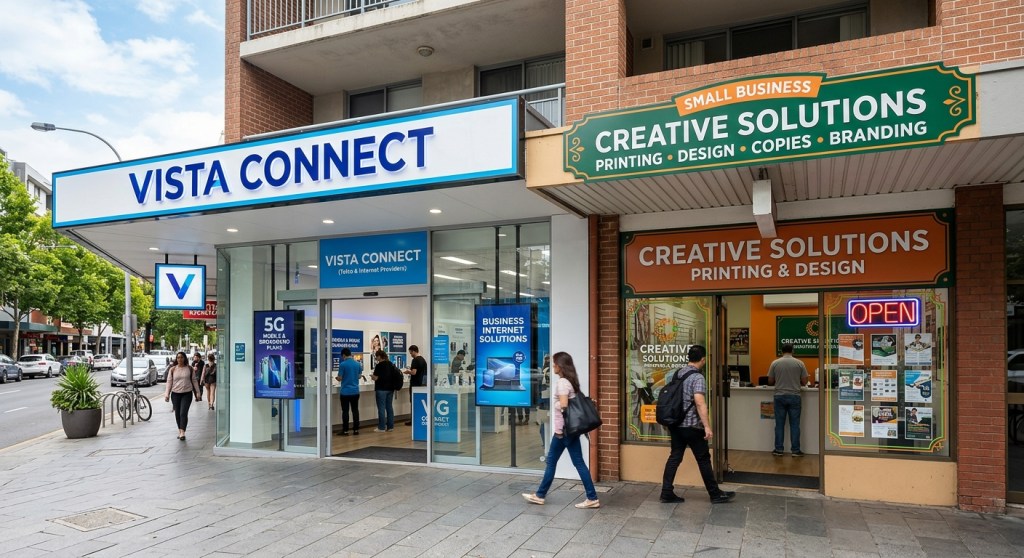
The core paradox: Despite representing 99% of businesses globally, 70% of global employment and roughly 50% of world GDP and having Telcos billing relationships with them for 30+ years, why what most operators earn from this segment barely extends beyond a few SIM cards per account. Why?
Analysts at Analysys Mason found that in 2023, operators’ SME revenue growth ran 3.3pps higher than equivalent large enterprise revenue growth. And yet the historical pattern has held: most telcos chased enterprise accounts and relegated SMEs to a consumer-lite afterthought.
SMEs telecom voice and data services market sits at $44b in 2025, rising to $75b by 2035. The “beyond connectivity” segment, covering security, cloud, productivity tools, and analytics, is projected to approach $700-800b by 2028, growing six times faster than core and near-core combined. Analysys Mason notes that SMEs already spend more than $66b on IT solutions from telcos, and 80% say they would consider taking more. This undoubtedly proves that the demand is definitely there.
Six structural issues that makes it difficult for Telcos every time
Applying enterprise GTM to SME Most telcos built their B2B muscle around large accounts: dedicated account managers, complex RFP-driven sales cycles, multi-year contracts. SMEs make faster decisions, work with tighter budgets, and have no use for quarterly business reviews. Pushing that enterprise model down-market produces a mismatch that drives churn aggressively.
One-size-fits-all packaging Consumer packs are too shallow. Enterprise bundles are too large and too complex. SMEs, especially in the 10-to-50-employee band, fall into a gap most telcos never bothered to fill or understood how to find that balanced middle ground answer. Rigid packaging forces an all-or-nothing decision that time-poor owners default to declining, and they assemble the pieces from elsewhere.
No customer value management for B2B Telcos have long mastered CVM in consumer: propensity models, churn triggers, next-best-offer engines. Almost none of this has been effectively applied to SME. The segment gets treated as stable connectivity revenue rather than a relationship to be managed and grown. Think how many Telcos have a live SME 360 view already? Churn signals go unread until the account is already gone.
Measuring ARPA instead of CLTV Running SME on average revenue per account means a new customer on a promotional rate looks identical to a long-tenured full-bundle customer. No signal to retain, no incentive to upsell. A global study covering 31 markets found that 95% of customer lifetime value comes from customers retained three or more years. Telcos consistently sacrifice that back-end value for front-end acquisition metrics.
Weak channel strategy Two options: a self-serve digital portal or a full account manager. Neither meets SMEs where they actually are. SME owners consistently want a hybrid: digital speed for routine decisions, and immediate human support when something breaks or a decision carries real financial weight. In the absence of that, local MSPs and IT resellers have quietly moved into the trusted-advisor role.
No earned trust, no advisory relationship Most telcos do not engage SME customers in any meaningful way between billing cycles. No proactive support, no advice, no local presence. SME owners are cautious about sharing business data with new providers, a hesitation that becomes a wall when telcos ask for it before earning the relationship. For a segment that buys on trust, that absence is itself a competitive disadvantage.
The Churn Problem Is Worse Than Most Telcos Admit
The vcita 2024 SME survey, covering 250 SME owners, is among the most direct reads on why small businesses leave their telcos. Churn rates range from 8% to 12% depending on service category, with network security and cloud services seeing the highest switching rates. The primary driver is price, but the more instructive finding is the second: 16% of SMEs that switched did so because they found a more relevant package elsewhere. That is not a pricing failure, but a product design and segmentation failure. The services were there, but they were not bundled in a way that made sense for the business.
The acquisition math makes this doubly painful. Bringing in a new telco customer costs 6 to 7 times more than retaining an existing one. A 1pps reduction in churn can lift profits by 5%. For an operator with a million SME accounts, the difference between 10% and 8% churn is not just a number, it is a material P&L line.
The Competitive Threat Telcos Systematically Underestimated
While telcos debated internal org charts and SME segment sizing, the competitive map shifted. The threat did not come from other telcos, rather came from two directions at once.
Hyperscalers took the application layer. In Q4 2025, AWS, Microsoft Azure, and Google Cloud together accounted for over 65% of global cloud infrastructure spending, with all three reporting SMEs and startups as their fastest-growing segment. These providers increasingly own the buying journey. When an SME owner needs cloud storage, they open an AWS console and not a telco portal.
Local MSPs took the trusted-advisor relationship. The managed service provider market is fragmented and sector-specific, but it fills gaps wherever telcos leave them. For a time-poor business owner, a single accountable local partner who knows their industry and shows up in person matters more than any individual product in a catalogue.
The security gap alone illustrates how wide the opening became. SMEs invested $107b in cybersecurity in 2023, a figure forecast to grow at 10% CAGR through 2028, by which point SMEs will account for 62% of all cybersecurity expenditure worldwide. A 2025 survey found 74% of SME owners self-manage cybersecurity without sufficient training, and one in three experienced a successful cyberattack in the prior year. Telcos, with existing billing relationships, network visibility, and brand trust, are structurally better positioned than any hyperscaler to own this at the local level.
What the Winners Did Differently?
A handful of telcos have broken the pattern. The details differ, but the logic is the same: they stopped selling products to SMEs and started owning outcomes for them.
Singtel
→ Partnered with Enterprise Singapore and IMDA to give 49,000 SMEs 12 months of complimentary security coverage and subsidized cybersecurity workshops, tied directly to Singapore’s SMEs Go Digital agenda.
→ Positioned as the SME’s navigator into government digital subsidy programs, converting public funding into commercial relationships before competitors could.
→ Built sector-specific propositions rather than generic SME bundles; consistently cited among the top-performing telcos in B2B marketplace alongside A1, AT&T, Telus, and Telstra
Vodafone Business, V-Hub
→ Built V-Hub, a free digital advisory platform for SMEs across 14 markets. Over 5m users, proving SME appetite for a telco that offers guidance and not just gigabytes.
→ Combined partner solutions from Microsoft and Google with its own service layer, positioning itself as the integrator, not just the connectivity pipe.
→ April 2026: launched an AI concierge for SME inbound calls and scheduling, alongside a managed detection and response security offering in partnership with Google Cloud.
Turkcell, Digital Business Services
→ Digital business services revenue hit TRY 4.4b in 2024, with recurring service revenues up 19% year on year: a subscription-based B2B stack that moves well beyond SIM cards.
→ Techfin segment (Paycell) grew 33% in Q4 2024, integrating fintech into the SME value stack rather than treating it as a separate product line.
→ ARPU growth driven not by price increases but by expanding the service footprint per account: the CLTV model working in practice
Jio: AI at SME Scale
→ Jio’s Haptik platform deployed WhatsApp and voice-based AI agents for 50,000 SMEs, targeting 300k to 500k subscribers within 2 years.
→ Early adopters report 80% of repetitive customer support queries resolved automatically, and 20 to 25% improvement in lead-to-sale conversion rates.
→ Shows how AI-powered self-serve can operate at scale without abandoning the human layer for decisions that matter.
Deutsche Telekom: Voice AI Notes
→ September 2025: launched Voice AI Notes for SMEs, automatically recording, transcribing, and summarizing phone calls through Telekom’s cloud system.
→ Directly addresses the primary adoption barrier: SME owner time scarcity. Not technology access. Time.
→ Positions the telco as a workflow partner and not a utility provider
4 shifts if executed well, could solve it for Telcos?
01. From connectivity provider to outcome orchestrator: The orchestrator model runs on a clear division of labour. The telco owns the billing relationship, service assurance, and customer accountability. Hyperscalers supply application depth and cloud infrastructure. Local IT providers bring sector-specific expertise and in-person support. The SME owner gets one interface, one invoice, one number to call. The telco is accountable for all of it. This model amplifies what telcos already have, without requiring them to build every capability from scratch.
02. From ARPA to customer lifetime value: A global telecommunications study covering 31 markets found that 95% of customer lifetime value comes from customers retained for three or more years. Retaining an existing SME customer costs roughly 10 times less than acquiring a new one. Global telcos currently capture only 60% of their full customer value potential. Shifting to a CLTV lens changes every downstream decision: modular bundles that grow with the account, proactive intervention before churn signals surface, human engagement at moments that carry financial weight for the owner.
03. From digital-only or human-only to a genuine hybrid: SME owners want to buy, manage, and expand services digitally without calling anyone. But when something breaks or a decision carries real risk, they want a human available immediately. Most telcos have built one or the other. AI handles the routine and the scalable. Human advisors step in for onboarding, incident resolution, and high-stakes decisions. The winners build both, working in parallel.
04. From uncommitted channel strategy to a deliberate partner model: Some telcos should build direct SME relationships. Others should lean into reseller-led models, using MSPs as the primary route to market. Both can work. Doing both without commitment produces neither. Forrester’s research on SMEs noted that reaching widely dispersed SME customers requires a portfolio of channels including direct, VARs, outbound, and online portals working in concert. The channel decision matters as much as the product decision.
The Policy Pull Opportunity Nobody Is Using Effectively Enough
There is an underutilized lever that very few telcos have acted on strategically and effectively: government digitization subsidies. Germany’s Digitalbonus Bayern program funds up to 50% of eligible SMB digitization and IT security expenses. Singapore’s government co-funded cybersecurity workshops through its SMEs Go Digital agenda. Yet most SMEs remain unaware that these programs exist or how to access them.
Telcos that position themselves as the SME’s navigator into the subsidy landscape, helping owners identify, apply for, and maximize government digitization grants, convert public spending into commercial relationships before they have to compete on price at all. Singtel’s partnership with Enterprise Singapore and IMDA is the clearest example of this working at scale. It does not cost the telco the revenue. It converts latent SME digital intent into live customers, with government absorbing the adoption cost.
The Window Is Open, But May Not Stay That Way
The assets telcos need is already in place: existing billing relationships, network infrastructure, regulatory familiarity, local brand presence. What is missing is an operating model built for SME, not borrowed from consumer or large enterprise.
✦ Build vertical-specific propositions, not generic SME bundles. Healthcare, retail, and professional services each have distinct needs, risks, and vocabulary. Generic offers win generic NPS scores. Vertical specificity wins retention and referrals.
✦ Lead with security as the entry point. The need is immediate, the anxiety is high, and the local provider with an existing billing relationship is better placed than any hyperscaler to own it. Verizon’s Trusted Connection launch in March 2025 is worth studying.
✦ Use government subsidy programs as a GTM lever, not a footnote. Operators who guide SMEs through the funding landscape earn the trusted advisor relationship before making a single sale.
✦ Build the hybrid model: frictionless self-serve for routine decisions, immediate human access when it matters. AI handles the scale. Human advisors hold the relationship before and after the sale.
Every quarter of delay is a quarter in which the application layer, the trusted-advisor relationship, and the renewal conversation move further away toward hyperscalers, MSPs, and the SaaS platforms that did show up.
Sources: Analysys Mason (SME revenue forecast, SMB IT spending forecast); Infosys Knowledge Institute (June 2026); vcita / intandem (SMB Telco Survey 2024); Omdia / TelecomTV; Gintel Research; ASEAN Secretariat / OECD (SME Policy Index ASEAN 2024); IFC SME Finance Forum; World Economic Forum; UNESCAP; CustomerGauge (2024); Simon-Kucher global telecoms study 2025; Turkcell annual results 2024; Verizon Business 2025; Deutsche Telekom 2025; Vodafone V-Hub 2024-2026; Jio Haptik 2025.


Leave a comment