There is a tempting narrative circulating in boardrooms, policy circles, and tech press right now – that the AI race between the West and China is a high-stakes winner-take-all contest, and whichever side “wins” will reshape global technology for a generation.
In my view, that narrative is wrong, or more precisely – its asking the wrong question.
The right question isn’t “who wins the AI race“, it’s “whether we’ve already seen this movie before?” And yes, we have! It played out in the cloud market over the last decade, and the ending wasn’t a conquest, it was a partition. Understanding that partition, why it happened, and why AI is structurally positioned to follow the exact same trajectory is the most important strategic insight leaders can carry into the next three years.
Part I: The Cloud Precedent
In 2016, AWS held 53.7% of the global IaaS cloud market. Alibaba Cloud had 3.7%. The Western Hyperscalers – AWS, Azure, Google, looked like they were about to own the world’s digital infrastructure.
Fast forward to today:
Global cloud market share (mid-2026, Synergy Research):
– AWS: ~30%
– Microsoft Azure: ~20%
– Google Cloud: ~13%
– Alibaba Cloud: ~4% globally (but dominant inside China, some part of SEA)
– Tencent Cloud, Huawei Cloud: ~1–3% globally
On the surface, this reads as a Western sweep. The Big Three now hold a combined 63% of global cloud infrastructure, up from 62% in 2024. Chinese clouds never made it globally.
But look more carefully, and the picture is far more nuanced.
Inside China, the dynamic is entirely reversed. Alibaba Cloud, Tencent Cloud, and Huawei Cloud dominate their home market almost completely. Western hyperscalers have negligible presence in China, not because they lost on product quality, but because the combination of regulation, data sovereignty law, geopolitical friction, and government preference made it structurally impossible for them to win there.
Meanwhile, Alibaba Cloud peaked at 9.5% global market share in 2020, briefly sitting third in the world, ahead of Google, before retreating to 4% by 2024. What happened? The same forces that protected Chinese cloud inside China also constrained it globally. US chip export controls hit so hard that Alibaba abandoned plans to spin off its cloud division entirely. Its annual 20-F filing now dedicates pages to acknowledging that US export restrictions “may materially and adversely affect Cloud Intelligence Group’s ability to offer products and services.” Chip imports from the US to China fell 28% in 2024, squeezing upgrade cycles. Alibaba’s market cap collapsed from roughly $900 billion in 2021 to $200 billion by 2022, in large part due to geopolitical and regulatory risk repricing.
The cloud market, in short, didn’t produce a global winner. It produced two parallel worlds: a Western-dominated international market, and a Chinese-dominated domestic market, with a handful of genuinely contested neutral zones in Southeast Asia, the Middle East, and parts of Africa where the choice wasn’t predetermined by geopolitics.
This is the template and AI is following it with remarkable fidelity.
Part II: The AI Shock with Arrival of Chinese Models
DeepSeek’s R1 launch – A Chinese lab, funded by a quantitative hedge fund, released a frontier-class reasoning model that reportedly cost $5.6 million to train. For comparison, OpenAI, Google, and Anthropic spend hundreds of millions per frontier model run. The market registered its shock immediately: Nvidia lost $589 billion in market cap in a single day.
By early 2026, Chinese open-weight models had gone from background noise to structural force:
– Qwen (Alibaba) captured over 50% of all global open-source model downloads by March 2026. In February 2026 alone, it generated 153.6 million downloads, more than the next eight competitors combined (Meta, DeepSeek, OpenAI, Mistral, Nvidia, and others). It now has 180,000+ derivative models on Hugging Face, more than Google and Meta combined.
– MIT Technology Review reported that Chinese open-weight models accounted for 17.1% of global AI model downloads in the year ending August 2025, narrowly surpassing the US share of 15.86%, the first time China had led this metric.
– DeepSeek and Qwen combined went from barely 1% of the global AI market at the start of 2025 to approximately 15% by early 2026. By Q2 2026, Chinese providers collectively accounted for over 45% of traffic on OpenRouter, a major third-party AI model aggregator.
– MiniMax’s M2 model offers comparable performance to frontier Western models at roughly 8% of the price.
– Stanford and UC Berkeley researchers have trained their own top-performing models on Qwen at costs as low as $30–$50.
– 80% of US AI startups now use Chinese open-source models somewhere in their product development stack.
That last data point deserves to sit for a moment. The competitive disruption isn’t happening only in geopolitically neutral markets. It’s happening inside the United States itself, driven not by geopolitics but by pure economics.
Part III: The Geography of Adoption
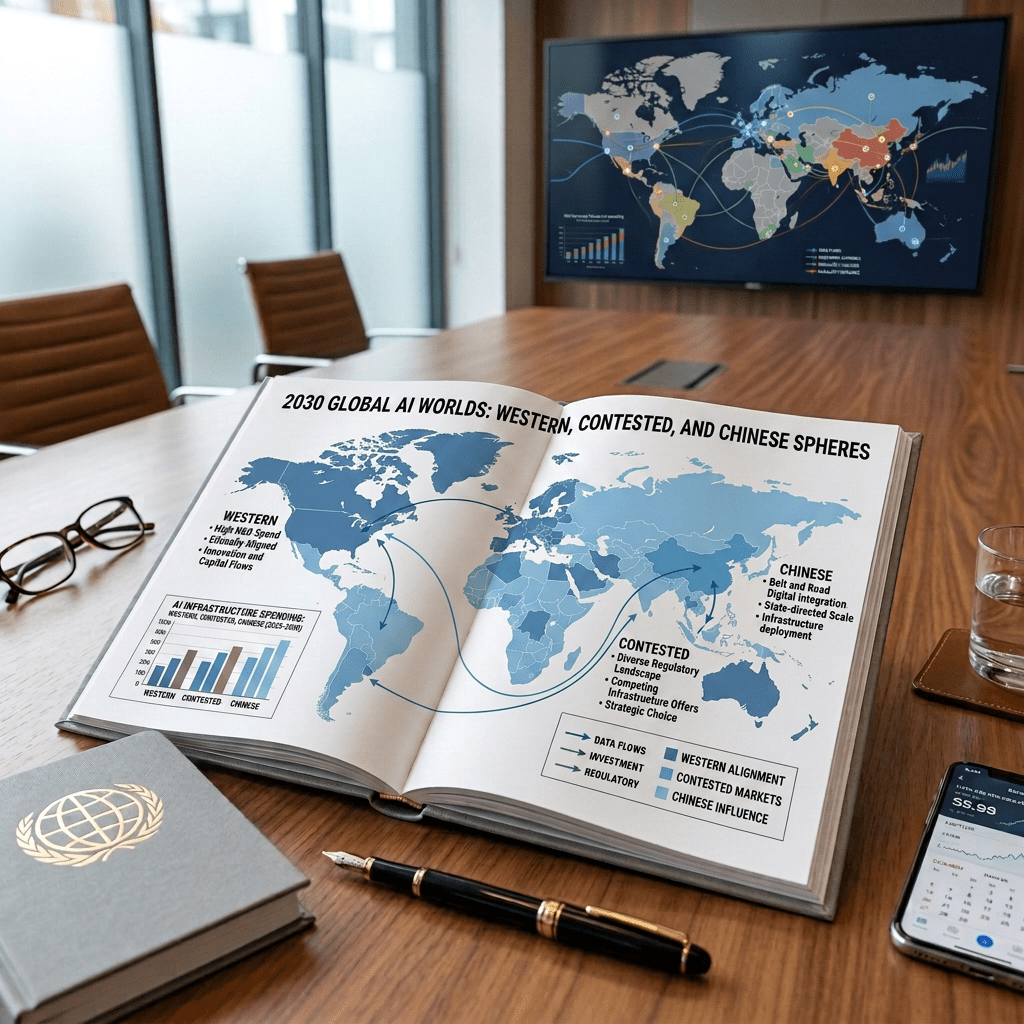
Here is where the cloud parallel becomes most instructive: the AI adoption map is already stratifying along familiar lines, and those lines look almost identical to the cloud partition.
The Western-aligned bloc: North America, Western Europe, Japan, South Korea, Australia, and most of the English-speaking world will default to Western AI systems; OpenAI, Anthropic, Google Gemini – for enterprise and government use. This is driven by regulatory alignment (the EU AI Act, US executive orders), data sovereignty requirements, trust and security frameworks, and deep incumbent ecosystem advantages (Azure-OpenAI integration, Google Workspace, etc.). The EU AI Act, entering full enforcement in August 2026 with penalties up to €35 million or 7% of global revenue, creates a compliance moat that further entrenches Western providers in Europe.
The China-aligned bloc: China’s domestic market is a closed ecosystem. ChatGPT, Claude, and Gemini are officially blocked in mainland China. Domestic models; Doubao, DeepSeek, Qwen, ERNIE, are the only real options. Beijing’s dual approach of allowing competitive development while maintaining strict regulatory oversight over public-facing AI services mirrors exactly how China managed cloud: encourage domestic champions, wall off foreign competition.
– Price sensitivity is high and Western AI pricing models are a barrier
– Geopolitical non-alignment means there is no default loyalty
– Data sovereignty ambitions are growing but infrastructure investment is limited
– Chinese open-source models, which can be self-hosted for free, offer a compelling value proposition
The contested middle: This is where the real race is happening, and it maps almost precisely to the cloud market’s battleground. Southeast Asia, India, the Middle East, Africa, and parts of Latin America are the genuinely open territory. These are markets where:
The evidence from the ground is striking. In Indonesia, developers openly acknowledge that Anthropic’s Claude is higher quality, but they choose the cheapest option. An Alibaba Qwen AI model advertisement now runs at Jakarta’s Soekarno-Hatta International Airport. DeepSeek’s adoption reached 56% in Belarus, 49% in Cuba, 43% in Russia, and is showing meaningful uptake in Ethiopia, Uganda, and across sub-Saharan Africa. Singapore’s government chose Qwen over Meta’s Llama to build its sovereign AI model on. DeepSeek now counts 130 million monthly active users, heavily concentrated in Southeast Asia and Africa.
The global sovereign AI market, valued at $40 billion in 2025 and projected to reach $148 billion by 2032 at a 20.6% CAGR, is the arena where this geographic battle will be most intense. Nations are building domestically controlled AI capabilities, and which foundation models they build on; Western or Chinese, will define the alignment of those sovereign stacks.
Part IV: The Structural Forces That Won’t Allow Any Convergence
Those who believe the AI race will produce a single global winner need to explain how the following structural forces resolve themselves:
1. Chip Export Controls
The US currently controls approximately 75% of global AI compute. China holds 15%. That asymmetry is a deliberate product of three years of escalating export controls. The Remote Access Security Act, passed by the US House in January 2026, would further restrict Chinese companies’ access to US AI cloud resources. Japan and the Netherlands have issued similar restrictions on chip manufacturing equipment. These controls do not just limit China’s compute; they create a permanent legitimacy barrier for Chinese AI in Western enterprise procurement and government contracts. The US Department of Defense classified Alibaba as supporting the Chinese military in 2026, triggering indirect procurement bans from 2027 onwards.
Chinese AI cannot credibly compete in markets where supply chain provenance matters and it will matter increasingly for financial services, defense-adjacent industries, healthcare, and critical infrastructure in Western-aligned economies.
2. Data Sovereignty and Trust
Enterprise AI adoption is not purely a capability or cost decision. It is a trust and governance decision. In Western-aligned markets, the questions being asked about Chinese AI models, who has access to the data? What content restrictions does the model have? Is the training data provenance clean? These are not easily answered in China’s favor. Chinese models are subject to CAC pre-launch assessment requirements and content filters that block discussion of politically sensitive topics. For global enterprise use, this creates a ceiling that has nothing to do with technical capability.
3. Open Source as a Wedge, And Its Limits
The Chinese strategy of releasing open-weight models is genuinely disruptive in ways the cloud equivalent never was. Unlike cloud infrastructure, which requires ongoing operational trust, open-weight AI models can be self-hosted, audited, and modified. This largely sidesteps the data sovereignty concern for technically sophisticated adopters. It is why 80% of US AI startups use Chinese models in their stack, they can isolate and control the deployment.
But open source has limits as a commercial strategy. It wins developer mindshare and enterprise experimentation. It does not easily translate into the kind of vertically integrated, high-margin enterprise relationships that sustain AI businesses at scale. Western providers are moving aggressively to build those relationships, Microsoft’s Azure-OpenAI integration, Google’s Workspace-Gemini embedding, Anthropic’s enterprise API relationships are creating switching costs that open-source access cannot easily overcome.
4. Regulatory Extraterritoriality
The EU AI Act is not just a European regulation. With penalties based on global revenue, it functions as a de facto global standard for any company that wants European market access, which includes most large enterprises worldwide. Western AI providers are building compliance architectures around this. Chinese providers face structural challenges meeting these requirements, given content filter mandates and data localization requirements that are often incompatible with European data protection law.
Part V: The Value Promise
Strip away the geopolitics and what remains is the question that ultimately determines long-term market share: which technology delivers better value?
Here the picture is genuinely competitive and will remain so.
On raw benchmark performance, Western frontier models, particularly from OpenAI and Anthropic, still lead in complex reasoning, safety alignment, and multimodal capability. But the gap has compressed dramatically. DeepSeek V3.2-Speciale achieved 96.0% on the AIME 2025 mathematics test, edging out OpenAI’s GPT-5 at 94.6%. Qwen leads in multilingual capability, particularly across Asian and Middle Eastern languages, where it demonstrably outperforms Western alternatives for regional enterprise use cases.
On cost, Chinese models have structurally won. The open-source availability of high-quality Chinese models has forced Western providers into pricing compression they did not plan for. OpenAI has responded with aggressive pricing to DeepSeek’s market gains. This is the competitive dynamic the cloud market never fully experienced, because cloud infrastructure cannot be as easily open-sourced, but AI models can, and that changes the economics permanently.
On ecosystem and integration, Western providers maintain strong advantages in enterprise workflows, compliance tooling, and the kind of deep vertical integration that large organizations need. Qwen’s integration with Alibaba’s commerce and payment ecosystem makes it powerful in Southeast Asian e-commerce contexts; it does not compete on the same terms with Azure’s enterprise suite in a global bank.
The honest assessment: neither side has a decisive capability advantage that will translate into global dominance. What they have are different capability profiles suited to different use cases and different deployment contexts.
Part VI: The Projection – Two Worlds
The data is consistent enough to make a defensible projection.
By 2028–2030, the global AI market will have structurally partitioned into:
Zone 1: Western Ecosystem (~55–60% of global AI revenue) North America, Western Europe, Japan, South Korea, Australia, and allied economies. Dominated by OpenAI, Anthropic, Google, Microsoft. Characterized by closed-source enterprise APIs, regulatory compliance architecture, high trust requirements, and premium pricing. Chinese AI presence minimal in enterprise; meaningful only in developer open-source stacks.
Zone 2: Chinese Ecosystem (~25–30% of global AI revenue) China domestic market and China-aligned economies. Dominated by Alibaba Qwen, ByteDance, Baidu ERNIE, DeepSeek. Characterized by domestic silicon, sovereign data requirements, state-aligned governance. Western AI effectively absent.
Zone 3: The Contested Middle (~15–20% of global AI revenue) Southeast Asia, India, Middle East, Africa, Latin America. Mixed adoption, driven by price, capability, and local political alignment. Chinese open-source models lead in developer adoption and cost-sensitive deployment. Western models lead in enterprise and government use cases requiring trust infrastructure. No clear dominant player; likely fragmented by country and sector.
This is almost precisely the cloud market structure, with the notable difference that the open-source dynamic gives Chinese AI a larger footprint in Zone 3 than Chinese cloud ever achieved.
The Strategic Implication
For business leaders, the implication is both clarifying and demanding.
If your market is primarily in the Western-aligned bloc, you are in a relatively stable ecosystem where Western AI providers will remain dominant. The choice between OpenAI, Anthropic, Google, and Microsoft will continue to be a product decision, not a geopolitical one. But you should expect continued pricing pressure as Chinese open-source competition forces Western providers to compress margins and accelerate capability timelines.
If your market spans the contested middle, i.e., Southeast Asia, the Middle East, Africa, you need to treat AI vendor selection as a genuine geopolitical and commercial decision, not a default to what your headquarters uses. The pricing differential between Chinese open-weight models and Western APIs is not a temporary feature; it is likely structural. Ignoring it is leaving value on the table. Embracing it requires navigating data governance, content filter limitations, and supply chain provenance questions that don’t have easy answers.
If you are building AI-native products for global markets, the multi-model, multi-geography reality is already here. The assumption that one model stack will serve all markets is as outdated as assuming one cloud provider would serve all geographies. The organizations that build modular AI architectures, capable of substituting models by deployment context, will have structural advantages over those that bet on a single ecosystem.
Conclusion: It’s Not a Race, It’s A Partition.
The most valuable insight from the cloud precedent isn’t strategic. It’s epistemic – the cloud wars produced breathless coverage of “which hyperscaler would win the cloud?” The answer was: none of them, and all of them. Each built enormous, durable businesses serving distinct and largely non-overlapping markets. Fifteen years in, the competition is vigorous, the innovation is real, and no single provider owns the world.
AI will follow this arc. The Western vs. Chinese AI race will not produce a decisive winner because the structural forces, geopolitics, regulation, data sovereignty, chip controls, open-source economics, and trust infrastructure and all of these will lead to visible partition.
The organizations that understand this earliest will build the most durable strategies. They will not ask “who wins the AI race?” They will ask: “which AI ecosystems serve which of our markets best, and how do we navigate both?”
It’s not a concession to complexity, but it’s the only question with a defensible answer.
The data points cited in this article draw from Synergy Research Group cloud market reports, MIT Technology Review’s 2025 AI model download analysis, Stanford HAI’s 2026 AI Index, Microsoft’s Global AI Economy Institute, OpenRouter usage data, Gartner IaaS market reports, and Alibaba Group’s FY2026 20-F filing. All market share figures are approximations reflecting the most current publicly available data as of mid-2026.


Leave a Reply